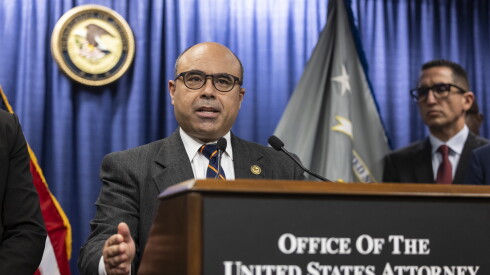
Chicago’s former FBI boss accused the city’s top federal prosecutor Monday of chasing political prosecutions at the behest of President Donald Trump and officials in Washington and then trying to cast blame when the “Broadview Six” case collapsed in spectacular fashion.
But by the end of the day, those explosive claims hardly seemed like the most pressing matter for U.S. Attorney Andrew Boutros. Instead, a federal judge had finally ordered Boutros to testify about claims he’s made about the failed prosecution of six Operation Midway Blitz protesters.
Seemingly at the end of her rope, U.S. District Judge April Perry wrote that Boutros and others “must” testify Nov. 16. Then, in a footnote, she wrote that she meant “must” in its “legal sense.”
“Which is to say it is mandatory,” Perry wrote.
Boutros did not comment throughout the extraordinary day that saw Douglas DePodesta, the former special agent in charge of the FBI in Chicago, file a nine-count lawsuit against Boutros, FBI Director Kash Patel, Attorney General Todd Blanche, the FBI and the Justice Department.
Boutros is considered the Chicago area’s top federal law enforcement official. He has denied that politics have played any role in his office’s charging decisions, insisting anyone who says otherwise is “an armchair expert who doesn’t know what they’re talking about.”
DePodesta’s sister-in-law is a defense attorney who represents a member of the “Broadview Six.” In his lawsuit, DePodesta alleged that Boutros falsely told his superiors in Washington that the pair “conspired to destroy the Broadview Six case.”
Federal law enforcement officials in Chicago routinely cite the importance of partnerships within the law enforcement community, so it’s stunning to see a former FBI boss sue his onetime colleagues — let alone to make such allegations.
But DePodesta told the Chicago Sun-Times in an interview that “the American people need to know what is happening within their government.”
“I was forced to leave my job,” DePodesta said. “I was ordered to leave my job.”
The lawsuit is being handled by U.S. District Judge Matthew Kennelly. Already, it has led to new revelations about what went on behind the scenes in the “Broadview Six” case. More could follow, if Kennelly decides to let the case move forward.
Meanwhile, Perry lit into the Justice Department for its handling of the “Broadview Six” fallout. She wrote in a seven-page order Monday that Boutros’ statements about the case are “hard to credit” and “nearly unfathomable.”
She even noted that Boutros made the comments at issue during an uninvited May 21 "monologue that spans five uninterrupted transcript pages.”
“The court concludes that there is more than an adequate factual basis for the court to pursue an inquiry as to whether willful false statements were made to the court,” Perry wrote.
Perry also insisted on testimony from three rank-and-file prosecutors who worked the case: William Hogan, Matthew Skiba and Andres Almendarez.
Justice Department officials did not respond to messages from the Sun-Times seeking comment Monday, but they will likely challenge Perry’s order.
Boutros first took office in April 2025 through a temporary appointment from then-Attorney General Pam Bondi. When that four-month appointment expired, Chicago’s federal judges chose Boutros to continue in the role on a more permanent basis.
A chorus of local elected Democrats called for Boutros’ resignation last summer, after the “Broadview Six” case imploded. But Blanche expressed support for Boutros, and the Chicago prosecutor remained in office. Meanwhile, there’s ongoing litigation out west over who can fire a judge-appointed federal prosecutor.
U.S. District Chief Judge Virginia Kendall declined to comment on the matter Monday, citing the code of conduct for federal judges through a spokesman.
Nancy DePodesta, the sister-in-law of Douglas DePodesta, said in a statement, “there is no one at the FBI who took their oath of office and their ethical and moral responsibilities more seriously than Doug.”
“It is both heartbreaking and shameful that he was forced out of his position based on what appear to be utterly false rumors spread by the U.S. attorney for the Northern District of Illinois,” said Nancy DePodesta, a former federal prosecutor in Chicago.
Boutros’ office brought criminal charges against 33 known defendants tied to Operation Midway Blitz, the Trump administration’s aggressive 2025 deportation campaign in Chicago. Only two of those individuals have been convicted. Most of the charges have been dropped.
Douglas DePodesta alleged in his lawsuit that the cases turned out to be an "unprecedented disaster” for Boutros’ office, and none more so than the “Broadview Six” case.
That prosecution revolved around a protest outside an immigration holding facility in west suburban Broadview in September 2025. Prosecutors alleged that a crowd pushed and damaged a federal agent’s SUV.
But from that crowd, only six people were charged with a conspiracy to impede the agent. Most of them were involved in local Democratic politics. Among them was Kat Abughazaleh, a high-profile progressive who ran for Congress in Illinois’ 9th District Democratic primary.
“Persons close to the Trump administration called for criminal prosecution of the protesters, particularly Kat Abughazaleh,” Douglas DePodesta alleged in his lawsuit.
Also charged were Oak Park village trustee Brian Straw, then-Cook County Board candidate Catherine “Cat” Sharp, 45th Ward Democratic committeeperson Michael Rabbitt, musician Joselyn Walsh and Abughazaleh campaign worker Andre Martin.
Nancy DePodesta represents Rabbitt.
Defense attorneys questioned whether the White House played any role in the case. But Boutros’ team told Perry there were “no communications of any nature from, to, or with anyone outside [the U.S. attorney’s office] (other than the local FBI investigators assigned to the case) regarding any investigatory or charging decisions.
“To be crystal clear, this specifically includes anyone in the White House” or at Justice Department headquarters in Washington, prosecutors wrote in a March 30 court filing.
Still, the case collapsed May 21 after Perry discovered apparent misconduct by Boutros’ staff while they sought an indictment against the group from a grand jury. Assistant U.S. Attorney Sheri Mecklenburg allegedly spoke to grand jurors outside the grand jury room and put her personal credibility on the line to support charges.
The judge also indicated Mecklenburg excused grand jurors who disagreed with the feds’ case, but Mecklenburg denies that claim.
Perry mentioned a fourth concern: The alleged misconduct had been redacted out of the transcripts initially given to her by the feds. She called that “the most problematic” issue of all.
But Boutros personally appeared in Perry’s courtroom and told her that “no prosecutor acted intentionally in misleading you.”
He also said he “only became aware” of certain misconduct by Mecklenburg in late April.
The “Broadview Six” scandal created an instant credibility crisis for Boutros, who endured bad headlines throughout the summer. Judges questioned whether they could trust his office, and one even ordered him into court over the violation of a seal order in a separate case.
Then, out of the blue, Douglas DePodesta announced his retirement from the FBI in early July.
“I’ve never backed down from a fight, as long as it meant our personnel could continue serving the FBI’s mission,” he told his team in an email on his way out the door.
“Unfortunately,” he added, “that has proven unpopular over time and my departure is a consequence of that.”
Now, Douglas DePodesta has alleged in his lawsuit that Boutros tried to blame him for the “Broadview Six” collapse — even though the case fell apart over allegations of misconduct in Boutros’ office.
The lawsuit alleges that Douglas DePodesta received a call in early June from Deputy FBI Director Christopher Raia, asking about the “Broadview Six” case. Raia allegedly shared a claim Boutros made to his Justice Department superiors about Douglas DePodesta.
Boutros told his superiors that Douglas DePodesta and Nancy DePodesta “had conspired to destroy the Broadview Six case,” according to the lawsuit.
Raia told Douglas DePodesta the allegations had created a stir and had made their way to Patel, the FBI director, the lawsuit states.
Douglas DePodesta allegedly told Raia the claims were “absurd” because the case disintegrated over improprieties by prosecutors. He also denied that he’d ever discussed the “Broadview Six” matter, or other cases, with his sister-in-law.
Raia agreed that the allegations didn’t make sense. Douglas DePodesta also called FBI Associate Deputy Director B. Chad Yarbrough, who said he understood Boutros’ statements weren’t true, according to Douglas DePodesta’s lawsuit.
But one month later, Yarbrough allegedly called Douglas DePodesta to tell him, apologetically, that Boutros kept making his claim. Yarbrough allegedly said Patel did not want the controversy — and told Douglas DePodesta to resign.
On July 6, Raia allegedly sent Douglas DePodesta a text message apologizing for “the way things went down.”
“You are widely respected in Chicago (and the FBI) and will be missed,” Raia wrote, according to the lawsuit. “The person replacing you will have big shoes to fill. I wish we could have given you the proper send off from [headquarters] that you deserve.”
Boutros’ team has been trying to contain the fallout from the “Broadview Six” scandal ever since. But crucial revelations are threatening to upend the case once again.
One of them surfaced in Douglas DePodesta’s lawsuit: It claims that Boutros met with Patel, Blanche and Assistant Attorney General Colin McDonald in Douglas DePodesta’s office on Oct. 7, 2025.
“During this meeting, Defendant Boutros discussed the Broadview Six investigation with his superiors in the Department of Justice and other law enforcement officers,” the lawsuit alleges.
Prosecutors first sought an indictment in the case two days later, records show. They finally secured it Oct. 23, 2025, after the case was initially rejected by a grand jury.
Still, the allegation in Douglas DePodesta’s lawsuit seems to undermine the claim made by Boutros’ team in March, denying they were in touch with anyone outside the U.S. attorney’s office about the “Broadview Six” case.
Boutros also acknowledged this summer that, in October 2025, he’d been emailed a transcript of a grand jury proceeding in which Mecklenburg allegedly put her personal credibility on the line. That’s a forbidden practice among prosecutors known as “vouching.”
Perry asked last month that Boutros’ office hand over records that could shed light on whether the feds had told her the truth. She did so as she is considering whether to name a special prosecutor to look into alleged wrongdoing by the feds.
But Associate Attorney General Stanley Woodward then inserted himself into the case Friday. He’s the Justice Department’s third-highest ranking official, and he’s increasingly finding himself at the center of its national controversies.
For example, Woodward faced off with U.S. District Judge Ana Reyes in Washington in the case over the East Potomac golf course just before Woodward entered his appearance Friday in the “Broadview Six” case, according to news reports.
With a deadline looming Friday to turn over the records to Perry, Woodward asked in a court filing that she clarify the point of her inquiry — and whether her “request” for documents was really a “directive.”
Woodward also told Perry “the United States has not agreed to provide any information” she’d sought.
Perry responded with her seven-page order around 3:30 p.m. Monday. It wasn’t clear if she’d been most bothered by Woodward, by Boutros, or the claims in Douglas DePodesta’s lawsuit.
But clearly, she’d had enough.
Perry said the timing of Woodward’s filing “could easily lead one to conclude that the goal of the filing was not to cure genuine confusion about the court’s order, but instead to inject unnecessary delay into these proceedings.”
She noted that, “generally, attorneys appreciate the opportunity to provide evidence that they have not lied to the court, and the court wanted to provide that opportunity to these prosecutors.”
She wrote that “the court’s inquiry is not a mystery to anyone who has had any involvement with this case or even conducted a cursory review of the docket.”
And she said that, since last spring, “the government has become what can only be described as cagey about its communications with those outside of the [U.S. attorney’s office.]”
Finally, she turned to Boutros. She noted that his presence in court the day the “Broadview Six” case collapsed “was not requested by the court, nor was he questioned by the court.” But she said he delivered a “monologue” in which he denied knowing about Mecklenburg’s “vouching” until late April.
“It has since come to light that at the time [U.S. Attorney] Boutros made that statement, he had for more than seven months been in possession of the transcript that contained — on the first substantive page — the vouching at issue,” Perry wrote.
The judge noted that a grand jury delivered an “exceedingly rare” rejection of the feds’ case that day, known as a “no bill.”
“To anyone who has been a federal prosecutor, a no bill would be an immediate red flag that something has gone very wrong in the grand jury,” Perry wrote.
And, she noted, “Boutros himself had to approve the re-presentment of the case to the grand jury.”
The feds went back to the grand jury Oct. 16 and Oct. 23, 2025, records show.
And, Perry pointed out, “the idea that [U.S. Attorney] Boutros would have made such a significant decision without reviewing the best evidence available to him about what went wrong in the grand jury is nearly unfathomable.”